LCEDG LEGISLATIVE FORUM

Property taxes front and center at forum

Reichman, Graber meet at forum in Montrose

Posted

MONTROSE –  According to one local legislator, there may be a law coming that will supercede a property tax law that is pinching local governments across the state.
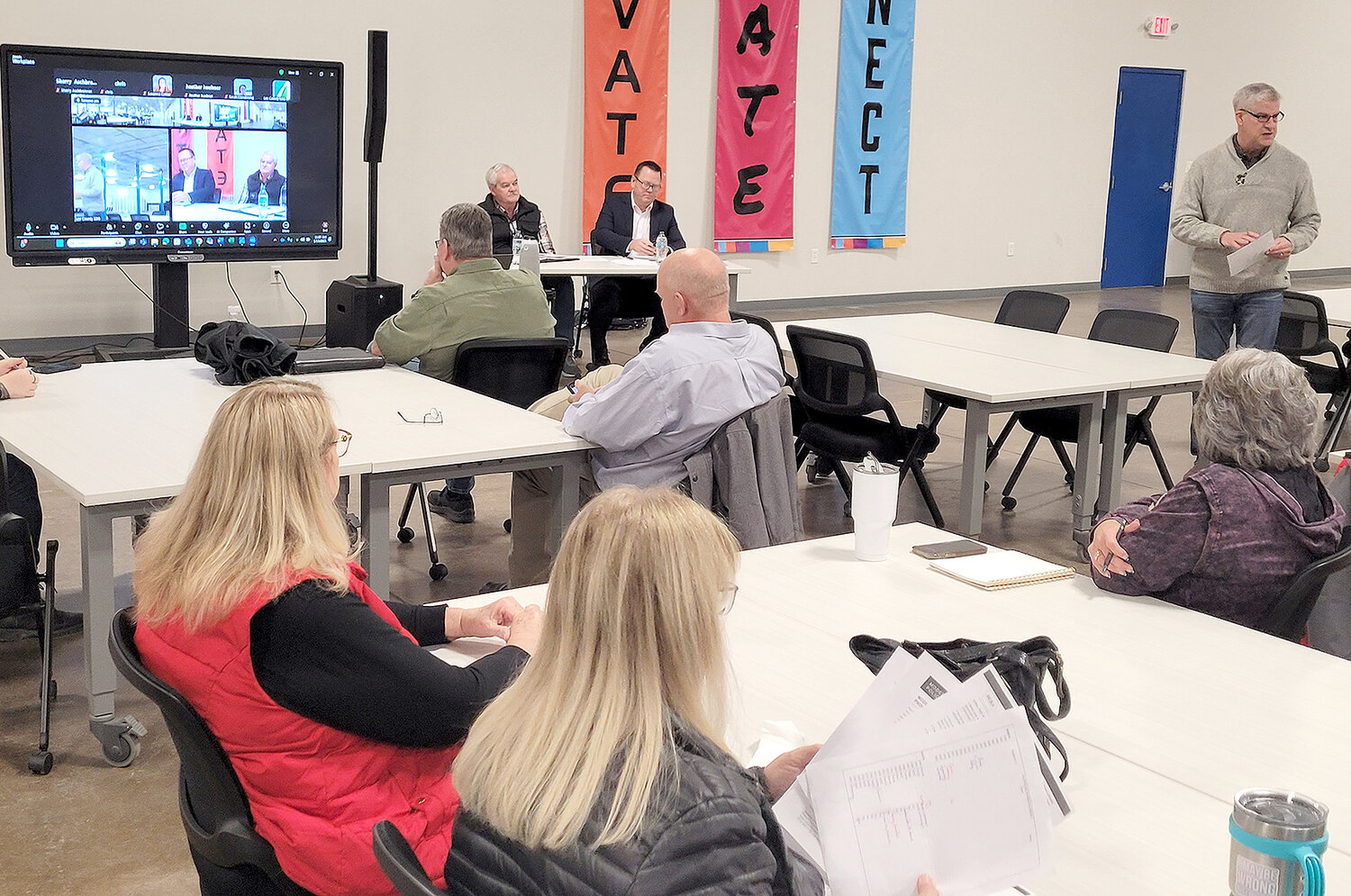
The Lee County Economic Development Group sponsored the first Legislator forum of the legislative session at LCEDG’s Montrose offices on Friday and property taxes were front and center.
Almost daily news stories are being written about the local governments across the state opposing the general fund property tax levy cap of $3.50/$1,000 assessed valuation that is now part of state code. All agencies have to be at or under $3.50 by 2029 under current law, and getting to that goal is resulting in a shifting and slashing of local government budgets.
State Sen. Jeff Reichman and State Rep. Martin Graber appeared at the forum. State Rep. Matt Rinker was a no-show.
Lee County Supervisor Garry Seyb asked if anything was on the agenda this year regarding amending the property tax law (House file 718 that was signed into law in the 2023 session), to soften the blow to local governments.
“We’re not moving anything this year? Is that what I’m hearing?” he asked.
Reichman said there would be no amendment to 718, but action is coming.
“I said there would be no amendment to fix the issue, but there will be a new law to supercede it,” Reichman said.
Although he didn’t go into detail, he said work on a new law is currently underway.
Seyb said the counties in the state are struggling. He said more than 30 counties that are currently over the $3.50 threshold are struggling, and those that are under $3.50 are struggling because they are capped,
“There are also some growth implications there in rural basic depending on how much you grow. If you grow too much in the rural area, you are being penalized,” he said. “Other things are affected as far as funding for farm-to-market roads.”
He said the change is a big deal with a huge impact to not only the county, but also cities and schools.
“I would encourage some work there,” he said.
He said the county has moved some line items from general supplemental, which is a different levy that pays county employee benefits, into the general fund to see some savings so in 2029, when they are forced to the $3.50, they can move some things back to the general supplemental.
“But there’s nothing left to move, so now we’re in fear of losing the option of having general supplemental at all.”
Lee County Auditor Sherri Yasenchok said a piece of the law states that the county has to mail out a letter outlining the property tax breakdown at a cost of about $8,000 per year. She said the county can’t answer questions about the city budget, or the school district’s budgets, but they are calling the county.
Graber said most people he talks to think the county is responsible for the property tax levy in its entirety.
“This is taxpayer money,” Yasenchok said. “And this is scary.”
Fort Madison City Manager Laura Liegois said she talked to city officials about HF 718 when she interviewed for the position last year and said Fort Madison officials weren’t well versed in the language. She had attended a state workshop on the bill. She said the bill was presented as a way to equal out all areas of economic development in the state.
“Right now, the city of Des Moines is facing a $17 million loss in revenues based upon all the things that have happened with property tax evaluations and this House File. They are making dramatic cuts there,” she said.
“I will tell you walking into budgets with my council and staff this year, we’re going to make it work. We’re not cutting too much, but we are moving some full-time people to part-time. I don’t think it should take a budget crisis to look at things and do them efficiently.”

Photo Caption
But she said the law has to be revisited because the city was able to make some one-time adjustments to the budget that aren’t sustainable year over year. She said the city is currently operating with three police vehicles that are 30,000 miles over their recommended life span.
“If things don’t change, the city will have to look at other revenues, including fees, or look at what services we can provide and that will change quality of life,” she said.
“I wanna grow this town. That is what I was hired to do, but I cannot do it with my council and our board of supervisors if we are going to be penalized for trying to grow.”
Seyb said the county is cutting everything they can including cutting six full-time positions that will not be filled through attrition. He said no one lost a job, but the service they provided is now not there.
“We’ve pulled back as far as we can pull back. And we’re going to get to the point where we can’t reduce anymore because there is no place to do that that won’t be catastrophic.”
Graber said when people are out knocking on doors, the number one thing people are saying from the Republican side is property tax.
“People are saying ‘I may not be able to stay in my house’,” Graber said. “Personally, I agree with people who are on fixed incomes who say they aren’t going to be able to stay in their houses.”
The law does provide for a seniors over 65 and military exemptions on property tax increases.
He said the more facts and transparency he has, the better it is for citizens to make intelligent decisions.
“It will come to a point in time where we’re going to say to them, fine you want us to cut the budget by 10%. Here’s the list of services we provide, what do you want us to cut,” Graber said.
Reichman said he was approached in Burlington by a city council person complaining about property tax caps.
“I said well I know a business owner whose property tax has doubled. Do you want a business there providing income to the city or do you want us raising taxes and running them out of business because that’s where they’re at,” he said.
“Everyone is feeling the squeeze. Everyone. My parents are both retirees and they are feeling it horrible. Everyone’s on a fixed income and everyone’s feeling it. But that is our number one issue that everyone worries about statewide.”
Former state senator candidate Nannette Griffin pushed the two on raising the pay for correctional officers at Iowa State Penitentiary with the recent attacks and attempted escapes that have occurred.
She said one offender got through the first wall and was close to getting out into the field if a tower guard hadn’t pointed something out. She said those employees were coming off a 16-hour shift.
Graber said he’d like to see and advocate for increased pay for C.O.s at ISP because they are handling the state’s most dangerous criminals. He said that can be done according to Iowa law now with recent legislation.
“We can pay them more than officers at other prisons in the state. As a matter of fact, it should be that way,” he said.
Supervisor Denise Fraise said she’d like the two to review a list of unfunded mandates that the state’s county auditors have compiled. Her biggest complaint was having to pay for state court services out of county budgets.
“Why does the county pay for that? That has always bothered me since I’ve worked there.”
Reichman said he would like to look at the list and hasn’t seen it.
“I agree. To force an entity to do something and then not provide for it doesn’t make sense.”
Legislative session are the held the third Friday of every month  through May at the LCEDG offices in Montrose.

legislators, Jeff Reichman, Martin Graber, forum, Montrose, Lee County Economic Development Group, sponsor, property taxes, unfunded mandate, correctional officer pay, news, Iowa, Lee County, Pen. City Current,

Comments

No comments on this item Please log in to comment by clicking here
